
ABOUT WELD-ON
Weld-On is a globally recognized leader in the development and manufacturing of high-performance solvent cements, primers, and adhesives for PVC, CPVC, and other thermoplastic piping systems. With decades of industry expertise, Weld-On has earned a reputation for delivering innovative and reliable bonding solutions that meet the highest standards of quality, safety, and environmental responsibility.
Committed to sustainability, Weld-On offers low-VOC and environmentally friendly adhesive solutions without compromising performance. Their products are trusted by professionals across plumbing, industrial, irrigation, and construction sectors for their superior strength, ease of application, and long-term durability.
As a valued partner, Weld-On continues to set the industry standard, providing cutting-edge solutions that enhance efficiency and reliability in piping applications worldwide.
FREE technical training available
Weld-On’s solvent welding course is your secret weapon to leak-free joints, fewer callbacks, substantial savings, and the ability to choose the best cement for every application!
Why Take Weld On’s Course
- Learn tried-and-true techniques to safeguard your plastic pipe and joint projects
- Bid and execute confidently with reduced repair expenses
- Deliver leak-free projects for happy, loyal customers
- Complete projects faster with fewer callbacks
- Know how to select the ideal cement for each application, ensuring longevity and strength
- Benefit from expert guidance and hands-on training provided by industry leaders in solvent welding who have trained over 30,000 professionals.
- There are increasing numbers of contracts specifying that bonders be qualified to the ASME B31.3 standard. Qualification may lead to a decrease in incidents and reduced liability insurance premiums.
DESIGNED INTO 3 training MODULES
Seminar Module
Classroom Training
The basic principles of solvent welding pipe and fittings
Techniques per ASTM D2855 standard
How to choose the right solvent cement for the job
Causes of joint failure
Safety precautions
Field Practice Module
Hands on Training
Interference fit check between pipe and fitting
Pipe-end deburring
Primer application
Solvent cement application
Pipe joint assembly
Bonder Module
Qualification
Participant makes a pipe joint assembly
The assembled sample is hydrostatically pressure tested per ASME B31.3 bonder qualifications standards
If the sample passes the pressure test, a qualification card is issued to the participant*
small diameter pipe welding guide
english
English
Spanish
frequently asked questions
What is the difference between PVC solvent cement and PVC glue?
Solvent welding is a chemical process that uses a primer, or the cement itself, to soften the surface of plastic pipe and fittings in order to weld, or fuse them together. This requires a tight, or interference fit. The solids contained in the solvent cement will then fill the gap between the pipe and fitting. Glue such as PVC glue, on the other hand, is only a bonding cement and will not work with an interference fit.
What is the purpose of a primer?
Primers pre-soften the surface of the pipe and fitting before the solvent cement is applied so that maximum fusion can take place.
What is the purpose of a cleaner?
To remove grease, dirt, and foreign matter from the surface of the pipe and fitting prior to application of the primer and cement.
What is Set Time? What is Cure Time?
The Set Time is the amount of time the joint is to be left undisturbed before handling. The Cure Time is the amount of time it takes the joint to be completely set and ready for pressure to be applied.
What does Low VOC mean?
VOC stands for Volatile Organic Compounds which are emissions from materials. Low VOC products contribute to cleaner air. The requirements for “Low VOC” have been established by SCAQMD Rule 1168/316A.
What causes the Cement Bead at the Socket Entrance to Sometimes Whiten (ABS, PVC, or CPVC) and is it Harmful to the Strength of the Joint?
This phenomenon is caused by moisture being drawn into the cement (only at the surface) during the first part of the curing process and is not harmful to joint strength.
Am I required to use Low VOC solvent cements and primers?
Low VOC solvent cements and primers are currently required in California, Maryland, New Jersey and Connecticut. Requirements are also under consideration in several other states, including New York, Rhode Island, and Maine. Even where not required, Low VOC products are a good idea because they contribute to cleaner air and a healthier environment.
How are Low VOC solvent cements and primers different than non-Low VOC solvent cements and primers?
Weld-On’s Low VOC solvent cements and primers provide the same performance, have the same installation properties, but are better for the environment and more user-friendly than non-Low VOC products.
Will CPVC solvent cement work on a PVC piping installation?
Yes. CPVC solvent cement technically will work on PVC piping. However, we recommend that the correct Weld-On primer and PVC solvent cement for the particular application should be used. Please note that PVC solvent cement, because of temperature limitations, is not recommended for CPVC piping.
Should the primer be dry before the solvent cement is applied?
No. The Weld-On primer must be wet and fluid. The purpose of the primer is to soften the joining surfaces of the pipe and fitting allowing proper penetration and dissolution of joining surfaces prior to Weld-On solvent cement application. This step is specifically recommended for large diameters, PVC Schedule 80, CPVC piping and cold weather installations.
Will the dauber, inside a quart can, work on 8-inch diameter pipe and fittings?
No. For 4-inch and larger diameter piping, we recommend the use of 4-inch swab to apply our primers and solvent cements. A can dauber is appropriate for use on pipe diameters that are approximately twice the size of the dauber diameter.
Is the application of primer necessary on irrigation piping system?
No. However, we recommend the use of primer on all PVC piping systems. Some Weld-On PVC solvent cements for irrigation piping can be used without primer on non-pressure systems if local codes permit.
Since there are so many primers and solvent cements available, how should I select the correct products for my job?
Identify the parameters of the particular application:
- Pipe material – PVC, CPVC, ABS
- Schedule or SDR of piping – Sch.40, Sch.80, SDR21, etc.
- Pipe diameter
- Working pressure of piping system
- Ambient temperature at the time of installation
- Temperature of media conveyance within the piping system
- Type of media being conveyed within the piping system – water, specific chemicals, etc.
- Other variables which may affect application and/or piping system
Consult the Weld-On Selection Guide and Product Guide for more information or contact your local Weld-On sales representatives for recommendation. Please call 1-800-888-8312 for your nearest Weld-On sales representative office. If further technical assistance is required, contact our Technical Service Hotline at 1-877-477-8327.
What is the shelf life of primers and solvent cements?
Weld-On primers, PVC and ABS solvent cements: 3 years shelf life
Weld-On CPVC solvent cements: 2 years shelf life
All Weld-On primers and solvent cements have expiration dates imprinted on the outside of the case boxes. Each can also has the expiration date and the manufactured date imprinted on the bottom. The shelf life is also stated in the product bulletin of each Weld-On product.
Where can I obtain information about Weld-On products?
Please refer to Product Literature and/or browse through our website for more product details.
What is the stronger part of a system, the pipe or the pipe joint?
In response to questions concerning solvent cement joint strength vs. PVC pipe pressures and surges; the shear strength of a well-made/fully-cured solvent cemented joint is always stronger than the individual pipe or fitting itself. This is regardless of the pipe diameter, schedule of wall thickness, PVC compound formulation, or system pressure/temperature.
Find your local rep
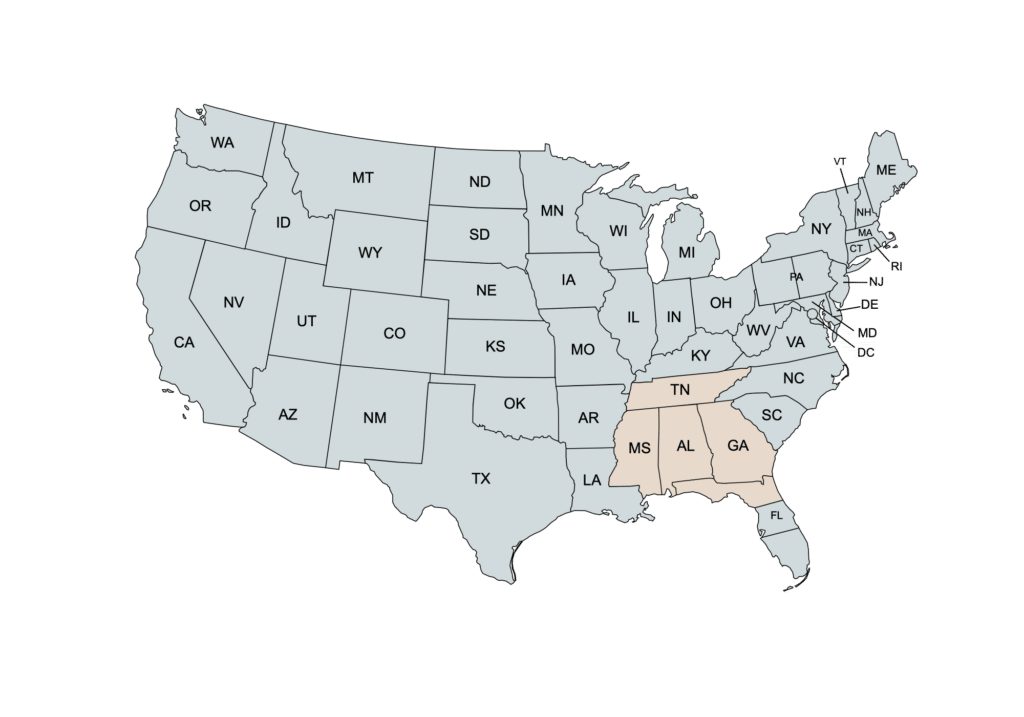
Mississippi
Tennessee